Online UPS vs Offline UPS: Key Differences, Advantages, and Which One Is Better?
Published: November 16, 2026
Contents
Introduction
A reliable power supply is essential for maintaining the performance and stability of electronic equipment. In residential, commercial, and industrial environments, unexpected power interruptions, voltage fluctuations, and electrical disturbances can disrupt operations, damage sensitive equipment, and potentially lead to significant financial losses.An Uninterruptible Power Supply (UPS) provides backup power and helps protect connected equipment from electrical problems. However, not all UPS systems offer the same level of protection. Two common UPS technologies are Online UPS and Offline UPS, each designed for different applications and power protection requirements.Understanding the differences between Online UPS and Offline UPS is important when selecting a suitable power protection system, particularly for businesses that rely on continuous electrical power to operate critical equipment.In this article, we will explore how Online UPS and Offline UPS work, their advantages and disadvantages, their key differences, and which technology is more suitable for industrial applications.
What Is an Online UPS?
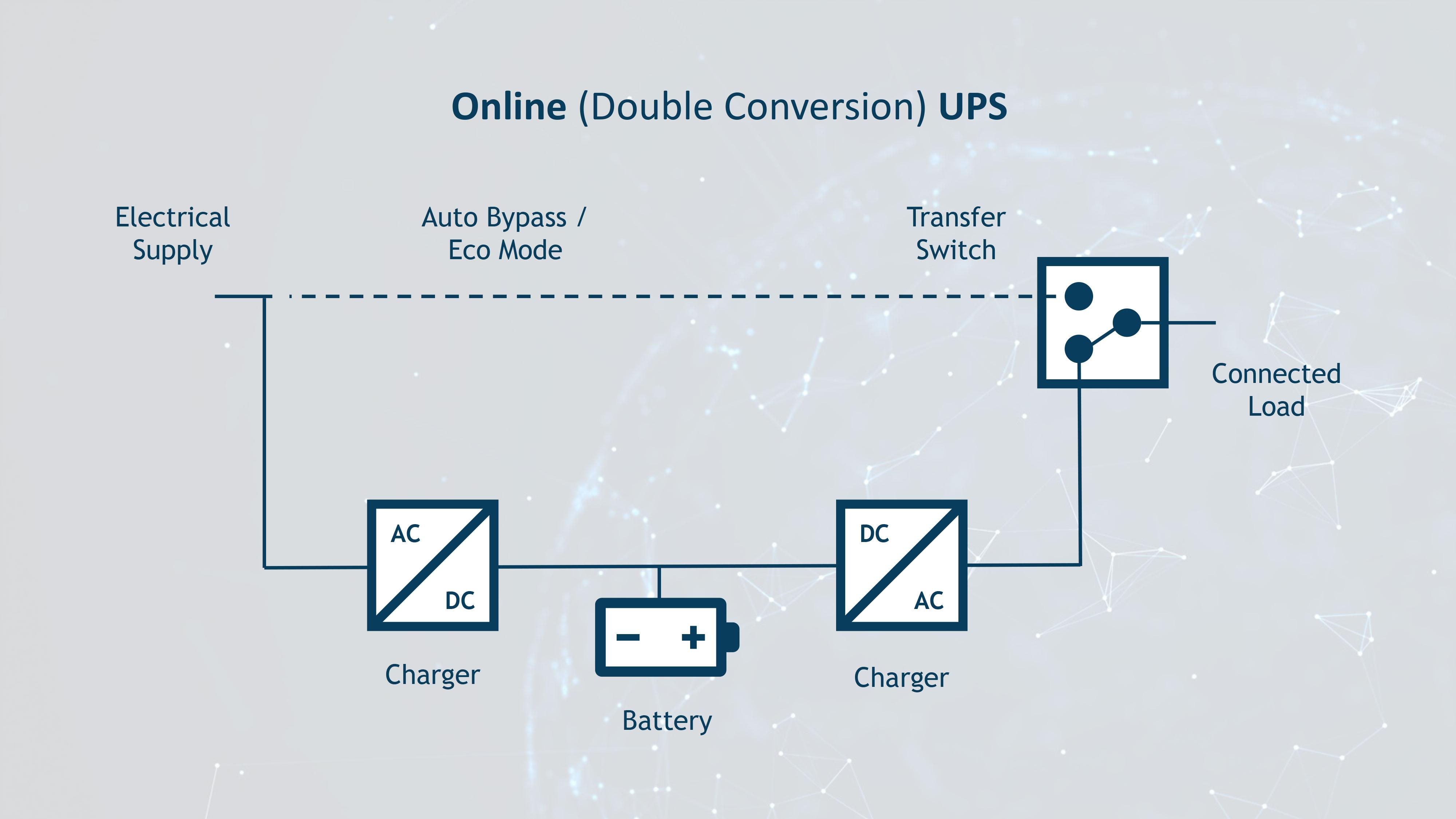
An Online UPS, also known as a Double Conversion UPS, is a power protection system that continuously supplies electricity to connected equipment through an internal rectifier and inverter.Unlike conventional backup systems, an Online UPS does not directly pass utility power to the connected load during normal operation. Instead, it continuously converts incoming AC power into DC power and then converts it back into AC power before delivering it to the equipment.This process is known as double conversion.
How Does an Online UPS Work?
An Online UPS generally operates through the following process:
AC Input: Electricity from the main power supply enters the UPS.
Rectification: The rectifier converts incoming AC power into DC power.
Battery Charging: The DC power supplies the battery charging circuit and maintains the battery's charge.
Inversion: The inverter converts DC power back into regulated AC power.
AC Output: The converted electricity is delivered continuously to connected equipment.
Because the inverter continuously supplies the load, the equipment does not experience a transfer interruption when the UPS switches to battery operation during a power failure.This technology also helps regulate output power and protect sensitive equipment from various electrical disturbances.
Advantages of Online UPS
1. Zero Transfer TimeOne of the most significant advantages of an Online UPS is its zero transfer time during a normal transition from utility power to battery operation. Since the inverter is already supplying the load, there is no conventional switching delay.This is particularly important for sensitive industrial equipment that requires uninterrupted power.2. Better Voltage RegulationOnline UPS systems continuously convert incoming power, helping maintain a stable output voltage even when the utility supply experiences fluctuations.3. Protection Against Electrical DisturbancesDouble-conversion technology provides protection against several common power problems, including:
Voltage fluctuations.
Power surges and spikes.
Undervoltage and overvoltage.
Electrical noise.
Certain frequency variations.
The actual protection level depends on the UPS design and specifications.4. Suitable for Critical ApplicationsOnline UPS systems are widely used in environments where power interruptions can affect essential operations, including manufacturing facilities, data centers, laboratories, and industrial automation systems.
Disadvantages of Online UPS
Despite its advantages, an Online UPS also has several considerations:
Generally has a higher initial purchase cost than an Offline UPS.
Its continuous power conversion can generate additional heat.
May require more sophisticated cooling and maintenance considerations.
Can have higher operating losses depending on its efficiency and operating mode.
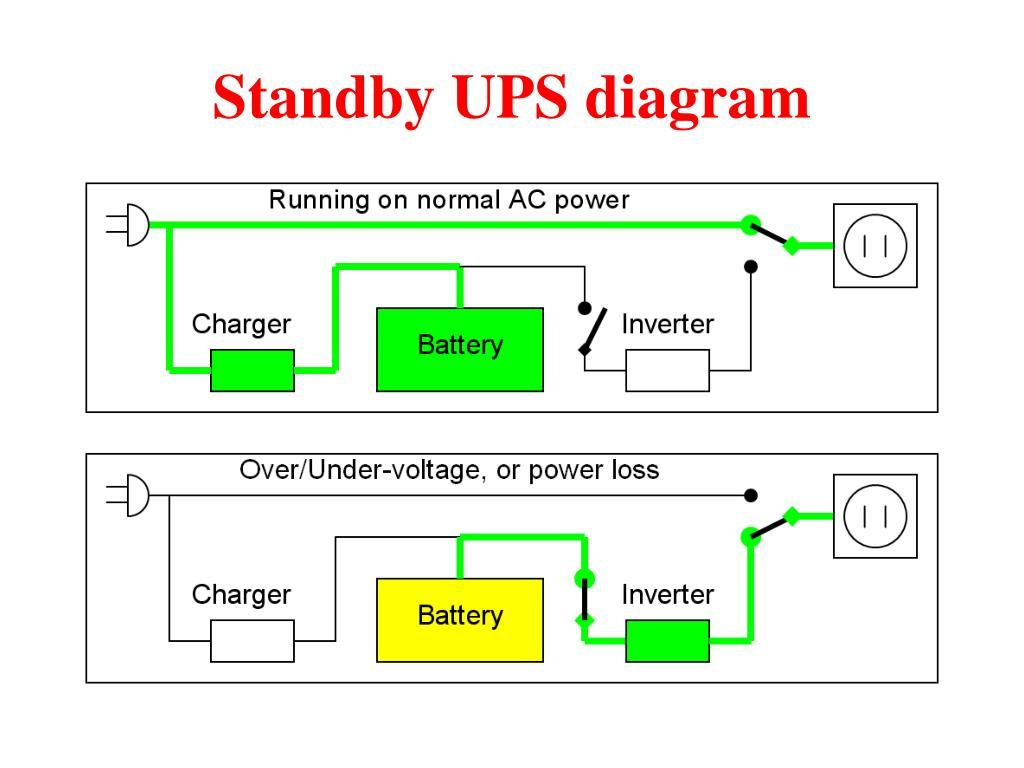
An Offline UPS, also known as a Standby UPS, is a basic UPS technology designed primarily to provide backup power when the main electricity supply fails.Under normal operating conditions, electricity from the utility supply passes directly to the connected equipment. The UPS monitors the incoming power and keeps its battery charged.When a power failure or certain abnormal voltage conditions occur, the UPS switches to battery operation and uses its inverter to supply electricity to the connected equipment.Unlike an Online UPS, an Offline UPS does not continuously process incoming power through a double-conversion system.
How Does an Offline UPS Work?
An Offline UPS generally operates through the following process:
AC Input: Electricity from the main power supply enters the UPS.
Normal Operation: Utility power passes through to the connected equipment.
Battery Charging: The UPS maintains the battery charge while monitoring the incoming electricity.
Power Failure Detection: When the utility supply fails or falls outside the operating limits, the UPS detects the problem.
Battery Activation: The inverter converts battery DC power into AC power.
Backup Power: The UPS supplies electricity to the connected equipment.
Because the system must switch from utility power to battery power, a short transfer time occurs during this process.
Advantages of Offline UPS
1. Lower Initial CostOffline UPS systems generally have a simpler design and lower purchase costs, making them suitable for applications with limited power protection requirements.2. High Operating EfficiencySince utility power normally passes directly to the connected equipment, Offline UPS systems can achieve high efficiency during normal operation.3. Simple Installation and OperationTheir relatively straightforward design makes them suitable for small-scale applications that do not require advanced power conditioning.4. Suitable for Basic Backup ApplicationsOffline UPS systems are commonly used for desktop computers, home electronics, point-of-sale systems, and other equipment that can tolerate a brief transfer time.
Disadvantages of Offline UPS
However, Offline UPS systems also have limitations:
Have a transfer time when switching to battery operation.
Provide less comprehensive power conditioning than Online UPS systems.
May not be suitable for highly sensitive electronic equipment.
Their ability to regulate voltage and protect against electrical disturbances is more limited.
For facilities with unstable power supplies or critical industrial equipment, these limitations should be carefully considered. Source: https://storage.googleapis.com/ddqnbzqiwrtwqe/standby-power-supply-circuit-diagram.html
Which UPS Is Better for Industrial Applications?
For industrial environments, selecting the right UPS technology is essential because electrical disturbances can affect production equipment, automation systems, monitoring devices, and other critical infrastructure.In many critical industrial applications, an Online Double Conversion UPS is generally the preferred option because it provides continuous inverter-based power and better output regulation.Here are several industrial applications where Online UPS technology can provide significant benefits.
A. Industrial Automation Systems
Modern manufacturing facilities depend on automation equipment such as Programmable Logic Controllers (PLC), Human-Machine Interfaces (HMI), and distributed control systems.Unexpected power interruptions can cause equipment shutdowns, process interruptions, and potential production losses.An Online UPS helps maintain continuous power to critical automation components, allowing systems to operate more reliably during disturbances in the main electrical supply.
B. SCADA and Industrial Control Systems
Supervisory Control and Data Acquisition (SCADA) systems are widely used to monitor and control industrial processes.Power interruptions affecting SCADA servers, communication devices, and control equipment can reduce operational visibility and disrupt monitoring activities.An appropriately sized Online UPS can help maintain power continuity for these critical systems.
C. Industrial Computers and Servers
Industrial computers are used for machine control, data acquisition, production monitoring, and other operational tasks.These systems may operate continuously and process important production data.An Online UPS provides continuous inverter-based power, helping protect industrial computers and servers from power interruptions and certain electrical disturbances.
D. Laboratory and Measurement Equipment
Laboratories and industrial testing facilities often use sensitive electronic instruments that require stable electrical power.Voltage fluctuations and unexpected power interruptions can affect measurement processes and equipment operation.Online UPS systems can provide improved power conditioning for these applications, depending on the equipment's electrical requirements.
E. Communication and Industrial Networking
Industrial communication infrastructure, including network switches, fiber optic communication equipment, and servers, plays an important role in connecting production systems.A reliable UPS system helps maintain power to essential network infrastructure, supporting communication continuity across industrial facilities. Source: yoosungkn.com
Why Is Power Quality Important for Industrial Equipment?
Power quality is an important consideration in industrial environments because modern production facilities rely heavily on electronic control systems and sensitive equipment.Electrical disturbances can affect equipment performance in several ways.Voltage FluctuationsUnexpected increases or decreases in voltage can cause electronic devices to malfunction, restart, or shut down.Power SurgesSudden voltage increases may damage sensitive electronic components if the equipment does not have adequate protection.Electrical NoiseElectrical noise generated by certain industrial equipment can interfere with sensitive electronic circuits and communication systems.Unexpected Power InterruptionsA sudden power failure can interrupt production processes, cause data loss, and require additional time to restore normal operations.An appropriate Online UPS system can help mitigate several of these problems by providing regulated output power and battery backup.However, UPS selection should also consider the overall electrical installation, grounding system, load characteristics, and other required protection devices.
Factors to Consider When Choosing an Industrial UPS
Choosing between Online UPS and Offline UPS should not be based solely on the initial purchase price.Several technical factors should be evaluated before selecting a UPS for industrial applications.
1. Connected Equipment Requirements
Identify which equipment needs power protection and determine its electrical characteristics.Critical automation systems, industrial computers, and sensitive instruments may require a higher level of power protection than ordinary office equipment.
2. UPS Capacity
UPS capacity must be sufficient to support the total connected load.Capacity selection should consider:
Total load in watts (W).
Apparent power in volt-amperes (VA).
Power factor.
Startup and peak power requirements.
Potential future load expansion.
Selecting an undersized UPS can result in overload conditions and unreliable operation.
3. Required Backup Runtime
Determine how long the equipment needs to remain operational during a power failure.Some applications only require enough backup time for a controlled shutdown, while others may require extended operation until an alternative power source becomes available.
4. Input and Output Voltage
Check the electrical requirements of the connected equipment.Industrial applications may require different output voltage configurations, including 110 VAC, 220 VAC, or other specifications depending on the installation.
5. Environmental Conditions
Industrial UPS systems must be suitable for their installation environment.Consider ambient temperature, ventilation, humidity, dust exposure, and available installation space.
6. Monitoring and Maintenance
For critical installations, consider UPS systems with monitoring capabilities such as SNMP, web-based management, alarms, and battery monitoring.Regular inspection and preventive maintenance are also essential to maintaining system reliability.
Related Articles
Continue reading about industrial automation and smart manufacturing