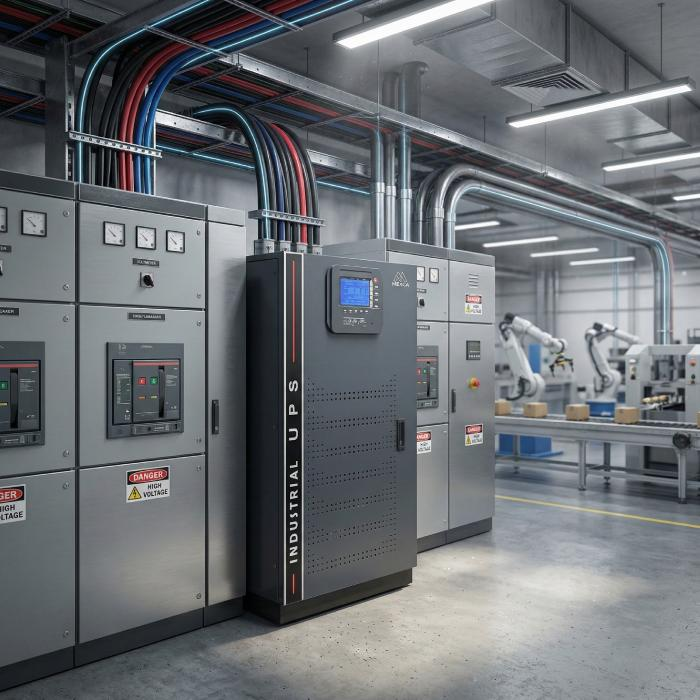
The Function of Transformers in Industrial UPS Systems
Published: September 5, 2026
Contents
Enhancing Power Quality, Electrical Isolation, and Reliability for Critical Industrial Loads
In modern industrial facilities, an Uninterruptible Power Supply (UPS) is not only used to provide backup power during a utility outage. It is also an important component of the facility’s power-quality and protection strategy.Industrial equipment such as PLCs, DCS systems, SCADA servers, industrial PCs, automation controllers, communication systems, instrumentation, and process-control equipment can be highly sensitive to electrical disturbances. For demanding applications, a transformer—particularly an isolation transformer—can be integrated into the UPS system to provide additional electrical protection and improve compatibility between the power source and critical loads.It is important to note that not every UPS requires a transformer. Modern transformerless UPS designs are widely used because they can be smaller, lighter, and more efficient. Transformers are added when their specific functions—such as voltage conversion, galvanic isolation, grounding/neutral management, or additional power-quality conditioning—are required by the application. Enhancing Power Quality, Electrical Isolation, and Reliability for Critical Industrial Loads
What Is the Function of a Transformer in a UPS?
A transformer in an industrial UPS can be installed on the input, output, or bypass side, depending on the electrical architecture and protection requirements.Its primary functions can include:
Voltage transformation
Galvanic isolation
Grounding and neutral-system management
Reduction of certain electrical disturbances
Harmonic mitigation in appropriate transformer configurations
Limiting fault current through transformer impedance
Improving compatibility between the UPS and the industrial load
The exact function depends heavily on where the transformer is installed and how the UPS and bypass circuits are configured.
1. Galvanic Isolation
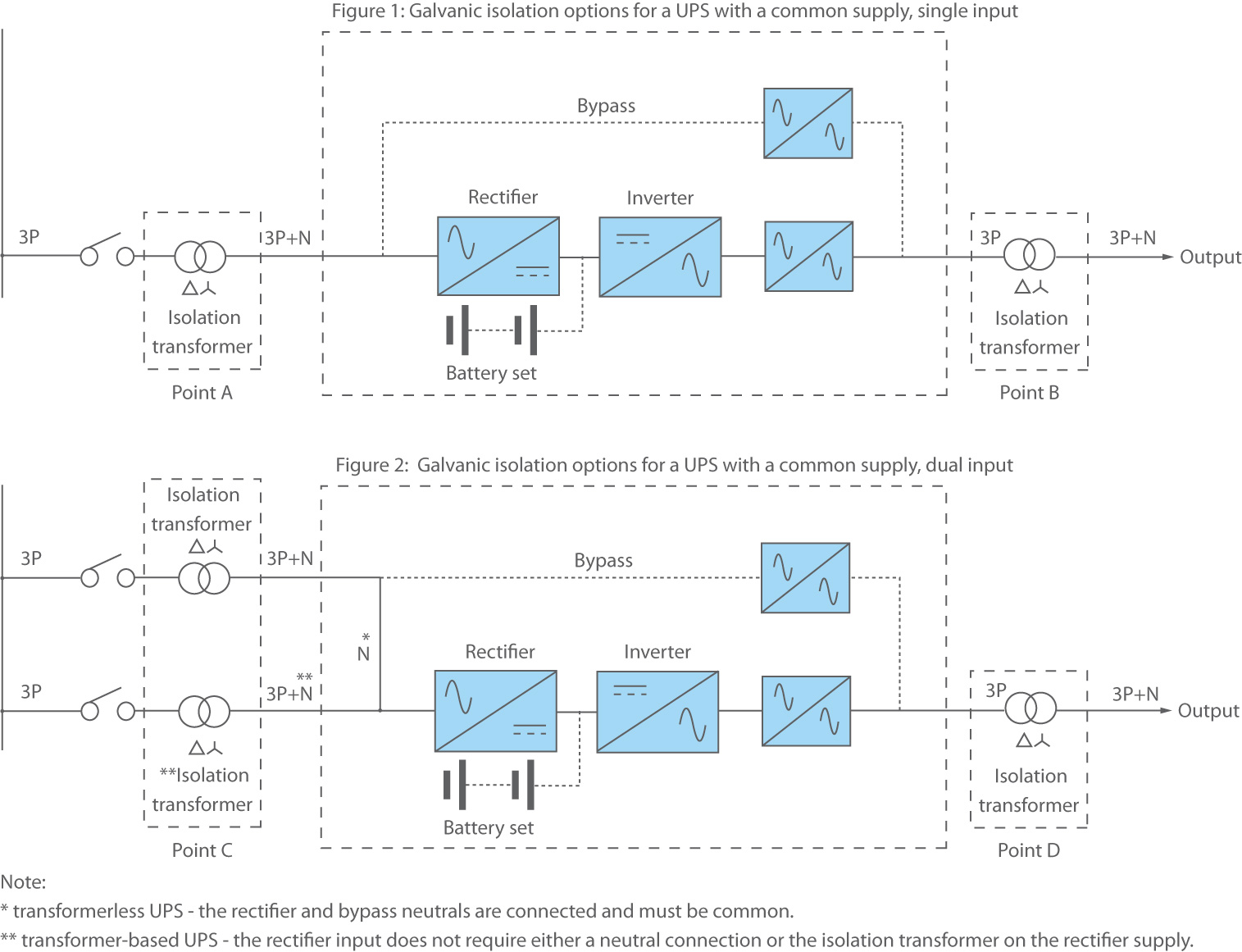
One of the most important reasons for using a transformer with an industrial UPS is galvanic isolation.A properly designed isolation transformer separates the primary and secondary circuits electrically while transferring energy through electromagnetic induction. This means there is no direct conductive connection between the two windings.In an industrial environment, this can help isolate sensitive loads from disturbances associated with the upstream electrical system.For example:Utility / Generator ↓ Input Transformer ↓ UPS Rectifier ↓ DC Bus + Battery ↓ UPS Inverter ↓ Output Transformer ↓ Critical Industrial LoadVertiv specifically describes input transformers as providing isolation between the primary and secondary sides, while output transformers can provide galvanic isolation for sensitive industrial loads.
Why is this important?
Galvanic isolation can help with:
Ground-related disturbances
Common-mode electrical noise
Certain fault conditions
DC components
Electrical separation between different power systems
For critical industrial applications, this additional separation can improve the overall robustness of the power system.
2. Voltage Step-Up and Step-Down
A transformer can also adapt the voltage between the UPS and the electrical system.For example, an industrial facility may have:400 VAC UPS output → Transformer → 230 VAC loador:400 VAC utility → Transformer → 230 VAC UPS inputThis allows the UPS to interface with loads or distribution systems operating at different voltage levels.Commercial UPS products also use step-down transformers for applications where the UPS voltage needs to be converted to a lower load voltage. Schneider Electric, for example, documents UPS isolation/step-down transformers designed to convert 208/230/240 V systems to lower-voltage outputs.However, transformer selection must be based on the actual UPS output waveform, harmonic characteristics, load profile, and manufacturer's requirements. A conventional transformer should not automatically be connected to a UPS output without verifying compatibility. Schneider Electric explicitly warns that standard transformers may not be suitable for some UPS outputs because of harmonic-voltage considerations.
3. Improving Electrical Isolation for Critical Loads
Industrial loads can be exposed to disturbances generated elsewhere in the facility.Large motors, variable-frequency drives (VFDs), welding equipment, compressors, switching power supplies, and other nonlinear loads can contribute to a complex electrical environment.An appropriately designed transformer can create an electrical boundary between the UPS/load system and the upstream network.This is particularly valuable for equipment such as:
PLC systems
DCS controllers
SCADA systems
Industrial computers
Measurement and instrumentation systems
Process-control equipment
Communication equipment
Laboratory and testing equipment
Riello UPS notes that isolation transformers can be used to separate UPS input and output supplies and suppress electrical noise, while transformer-based UPS architectures are commonly considered for industrial applications requiring galvanic isolation.
4. Grounding and Neutral Management
Another important function is the ability to establish or modify the grounding and neutral configuration.Different parts of an industrial electrical system may use different grounding arrangements. An isolation transformer can provide a separately derived secondary system, allowing engineers to establish an appropriate neutral-to-ground relationship according to the applicable electrical design and standards.For example, a transformer may be configured as:Delta → WyeThe secondary Wye configuration can provide a neutral point that can be grounded appropriately.This can be useful when:
The UPS input and bypass have different grounding arrangements
The downstream equipment requires a specific neutral configuration
Ground-loop problems need to be addressed
A separately derived system is required by the electrical design
Riello describes transformer arrangements that can recreate a fixed TN-S grounding system, while its galvanic-isolation documentation explains how transformer placement affects neutral separation.
5. Harmonic Mitigation
Industrial facilities frequently contain nonlinear loads such as:
Variable-frequency drives
Rectifiers
Switching power supplies
Battery chargers
Inverters
Industrial automation equipment
These loads can produce harmonic currents.A transformer is not a replacement for a dedicated harmonic filter, but its winding configuration and impedance can help mitigate certain harmonic components.For example, a properly designed Delta-Wye transformer can provide a path for triplen harmonics—such as the 3rd, 9th, and 15th harmonics—within the appropriate winding arrangement, reducing their propagation toward the upstream system.Schneider's Electrical Installation Guide notes that a transformer with a delta-connected primary can prevent third-harmonic currents present on the secondary from passing into the upstream power network.Modern industrial UPS manufacturers also identify harmonic reduction as one of the potential benefits of UPS systems equipped with appropriately designed output transformers.Important: harmonic performance must be evaluated using the actual UPS topology, transformer vector group, impedance, load spectrum, and system measurements. A transformer should not be assumed to eliminate all harmonics.
6. Limiting Fault Current
Transformer impedance can also influence the magnitude of fault current available on the secondary side.This can be useful when designing protection systems because the transformer introduces impedance between the upstream source and the downstream load.Eaton, for example, describes isolation transformers as providing electrical isolation and helping reduce short-circuit currents and voltage transients in related industrial applications.This can assist engineers when coordinating:
Circuit breakers
Fuses
Protective relays
UPS protection
Downstream distribution equipment
Protection coordination must nevertheless be calculated for the complete system rather than relying on the transformer alone.
7. Protection Against Electrical Noise
Industrial facilities can contain substantial electrical noise caused by switching devices, motors, drives, contactors, and power converters.An isolation transformer can help reduce the coupling of certain common-mode noise and high-frequency disturbances, particularly when the transformer is properly designed and installed.Some designs incorporate electrostatic shielding between primary and secondary windings to further reduce capacitive coupling of high-frequency noise.This is particularly useful for sensitive systems such as:UPS → Isolation Transformer → PLC / Instrumentation / Control SystemThe objective is not simply to provide backup power, but to create a cleaner and better-controlled electrical environment for critical equipment.
8. Protecting Sensitive Industrial Equipment
Industrial automation systems can be extremely sensitive to electrical disturbances.A short voltage disturbance may cause:
PLC resets
HMI shutdowns
Communication failures
Instrumentation errors
Controller faults
Production interruptions
Loss of process data
An industrial UPS already provides significant power protection through its power-conversion architecture. Adding an appropriate transformer can provide another layer of electrical separation and compatibility.This is one reason transformer-equipped UPS systems continue to be offered for industrial applications. Vertiv, for example, provides industrial UPS configurations with optional input, output, and bypass isolation transformers for applications requiring additional electrical isolation.
Transformer-Based UPS vs. Transformer-less UPS
Modern UPS technology increasingly uses transformerless designs.
Transformer-Based UPS
Advantages
Strong electrical isolation options
Flexible voltage conversion
Useful grounding/neutral configurations
Robust solution for certain industrial applications
Can provide additional harmonic-management characteristics
Considerations
Larger footprint
Higher weight
Additional heat losses
Potentially lower efficiency
Higher installation requirements
Transformerless UPS
Advantages
Smaller and lighter
Higher efficiency in many designs
Lower losses
Reduced physical footprint
Often lower operating cost
Considerations
External transformer may still be required for specific applications
Grounding and neutral requirements must be carefully engineered
Compatibility with bypass and load characteristics must be evaluated
For example, Vertiv reports different efficiency figures for transformer-free and transformer-equipped versions of its PowerUPS 6000 Industrial platform, illustrating the engineering trade-off between transformer functionality and efficiency.Therefore, transformerless does not mean unprotected. It simply means that the UPS does not rely on a conventional power-frequency transformer as part of its standard architecture.
Typical Industrial Applications
Transformers integrated with UPS systems can be particularly useful in:
Manufacturing Plants
For PLCs, robotic systems, production control systems, and industrial automation.
Oil & Gas
For critical control, instrumentation, communication, and process systems where electrical reliability is especially important.
Petrochemical Facilities
For DCS, safety systems, instrumentation, and process-control infrastructure.
Power Generation and Utilities
For control systems, protection systems, SCADA, and critical auxiliary equipment.
Mining
For critical automation and control equipment operating across electrically demanding environments.
Industrial Data Centers
For servers, network infrastructure, control systems, and other critical digital equipment.Vertiv specifically positions industrial UPS systems with isolation-transformer options for demanding environments including industrial applications, while Eaton notes transformer-based UPS technology has historically been used in industrial sectors such as oil and gas, petrochemical, chemical, utility, and heavy industry. UPS
Related Articles
Continue reading about industrial automation and smart manufacturing